A new pyramidal building was discovered near Caral, the pre-Hispanic city considered a World Heritage site for housing the oldest civilization in America, approximately 5,000 years old, according to Peruvian authorities. The building is located in the urban center of Chupacigarro, contemporaneous with Caral, in the Supe valley area, north of the Lima region, detailed the Ministry of Culture.
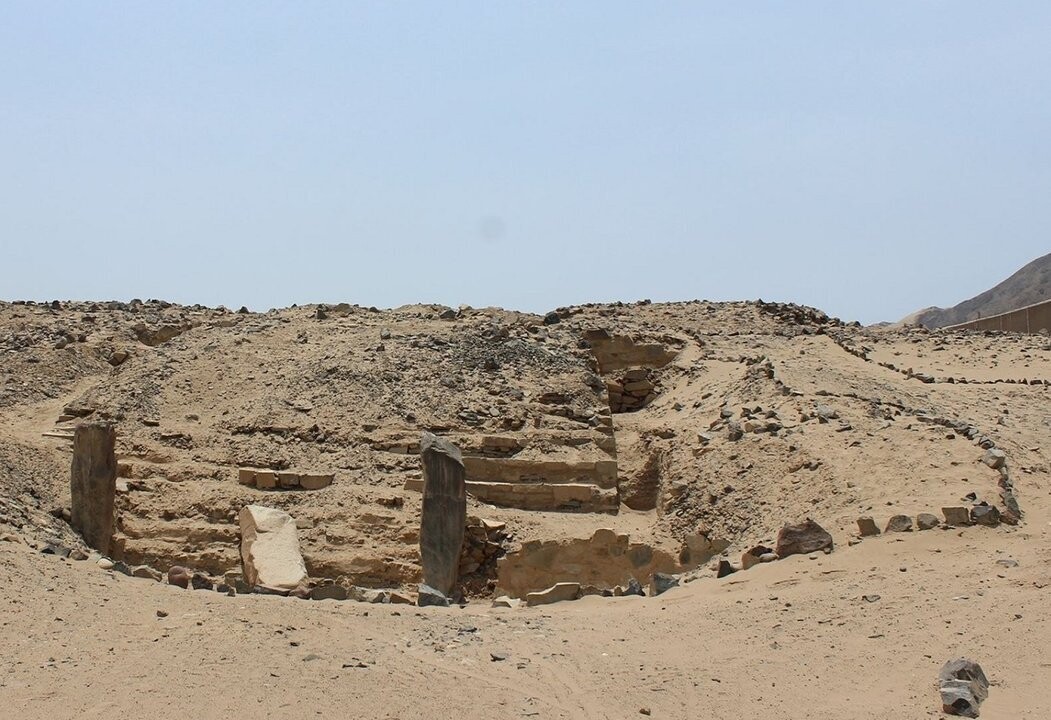
As part of the expansion of archaeological investigations in the area, the multidisciplinary team from the Caral Archaeological Zone discovered the construction in the so-called ‘sector F’ of Chupacigarro, one kilometer west of Caral. "Recent archaeological explorations allowed identifying this new building, which was covered by a small set of dry huarangos trees and weeds. Upon removing these shrubs, the stone walls that make up at least three overlapping platforms were visualized," explained the information.
The walls feature large stones placed vertically, known as ‘huancas,’ marking the corners of the quadrangular building, as well as a central staircase that allowed access to the top.
"The Culture Ministry stated that investigations in this new building will allow the team led by archaeologist Ruth Shady, the discoverer of Caral, to understand the complete urban layout of the Chupacigarro urban center, which will enhance the valorization of this settlement for it to be visited alongside Caral.
Chupacigarro is located in a small ravine and is part, along with the Sacred City of Caral, of a larger system that includes several archaeological settlements in the Supe valley, belonging to the Caral civilization (3000-1800 BCE). The ravine contains 12 structures considered public or ceremonial, located on the tops of small hills, around a central space.
According to experts, the buildings differ in size, orientation, and characteristics, apparently due to functional factors. In the periphery, residential architecture has been discovered, with small buildings presided over by a main one, which features a sunken circular plaza, typical of that historical period.
Chupacigarro was strategically located due to its proximity to the low valley and the coast, from which it obtained marine products. Additionally, the inhabitants had access to the riparian forest, puquios or springs, stone quarries, and agricultural fields. The settlement was not visible from the valley and must have been part of an extension of the Sacred City of Caral, possibly linked to a more private or religious function, highlighted the Ministry of Culture.
One of the most representative finds at the site is a geoglyph measuring 62.1 meters by 30.3 meters, visible only from a strategic point in the city of Chupacigarro. The large drawing depicts a profile head in the pre-Hispanic northern style of Sechín and was outlined with angular stones, with the face oriented to the east, the eye closed, the mouth open, and a representation of hair blown by the wind or ‘blood’ flowing from the head.